

There is a persistent myth living inside every kitchen showroom, every renovation mood board, and every big-box cabinet aisle: that a great wall cabinet must arrive pre-finished. Painted. Decided. That the factory coat of paint or stain signals quality, and that “unfinished” is a polite word for incomplete. Walk into any design consultation and someone — with a clipboard and a practiced tone — will steer you toward the glossy, the sealed, the already-chosen. The implication is clear: unfinished means you’re settling.
That myth deserves a serious challenge. And the Project Source Omaha Wall Cabinet is exactly the product that delivers it.
Five Omaha Wall Cabinets Worth Knowing
Before we get into why this line earns more respect than the market typically gives it, here is a look at the five most practical configurations in the Project Source Omaha Wall Cabinet series. Each one is built on the same foundational philosophy — solid poplar door construction, frameless full-access design, and a ready-to-finish surface that returns creative authority to the buyer.
1. Project Source Omaha Wall Cabinet — 36-in W × 30-in H × 12.5-in D (Model W3630B)
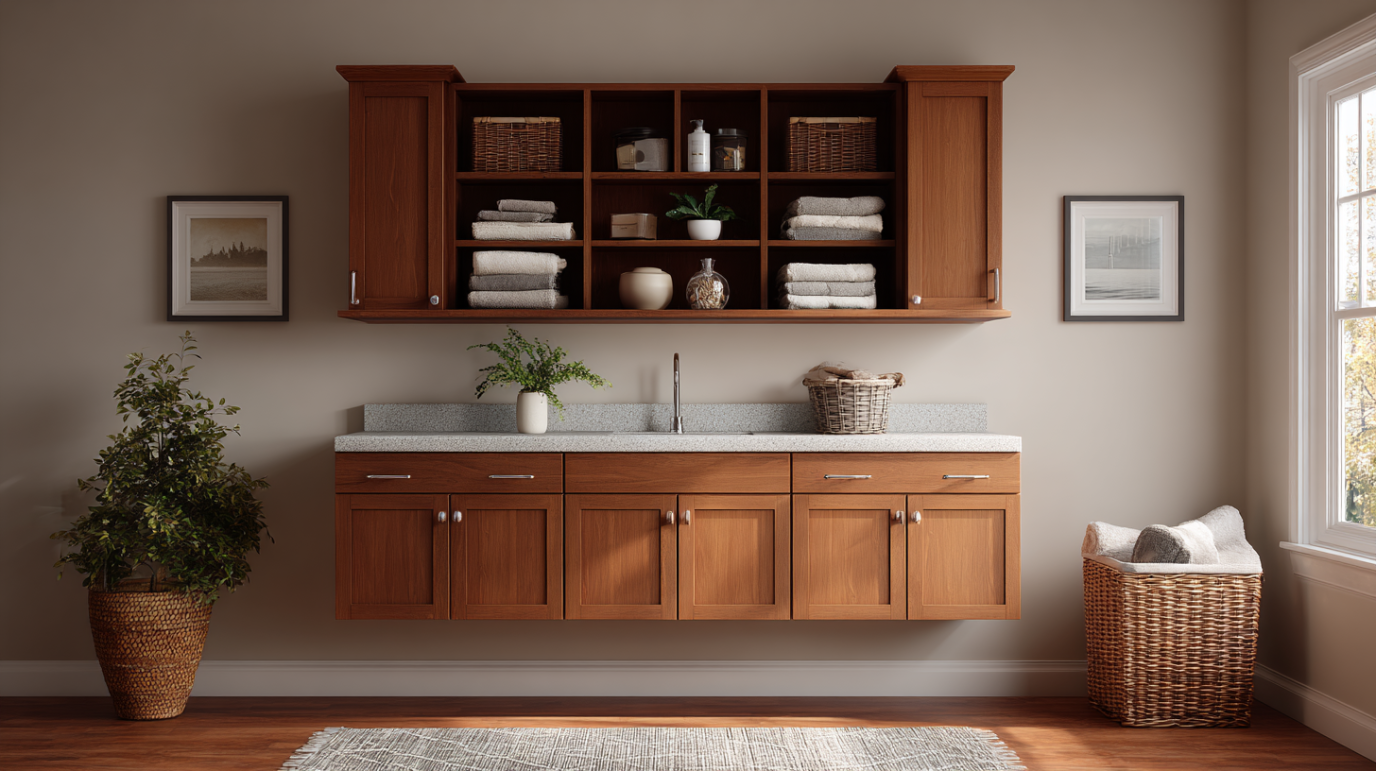
The flagship. The headline act of the Omaha line. At 36 inches wide and 30 inches tall, this configuration delivers the most expansive wall storage in the series, making it the natural anchor for any full kitchen layout. Two adjustable shelves, a recessed panel Shaker-style door built from solid poplar, and 6-way adjustable hinges make the W3630B as precise as it is capacious. This is the cabinet you plan around, not the one you squeeze in as an afterthought.
Rating: New to the shelves — Be the first to review
Price Range: Starting at $69.98
2. Project Source Omaha Wall Cabinet — 30-in W × 30-in H × 12.5-in D
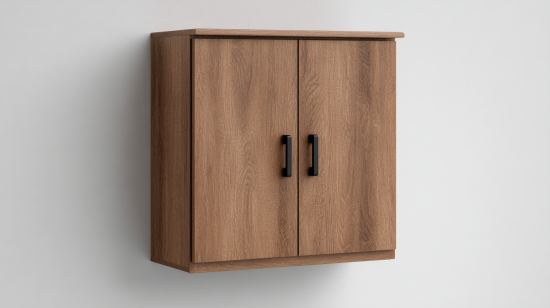
The workhorse that nobody argues with. Thirty inches wide, thirty inches tall — this configuration threads the needle between ambition and practicality in most standard kitchen layouts. It pairs cleanly with base cabinets, flanks windows without competing with them, and accepts any finish without complaint. Frameless construction means every cubic inch is genuinely accessible, not surrendered to a face frame that looks like storage and isn’t.
Rating: New to the shelves — Be the first to review
Price Range: Starting at $59.98
3. Project Source Omaha Wall Cabinet — 30-in W × 18-in H × 12.5-in D
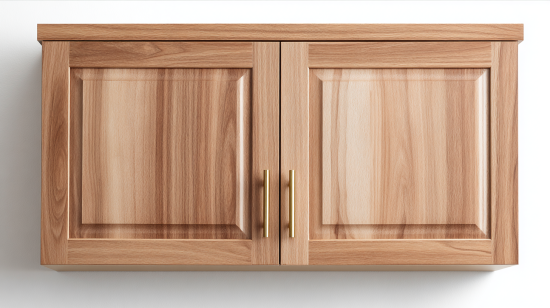
The above-appliance specialist. Not every wall cabinet needs to reach for ceiling height. This 18-inch-tall configuration answers the real-world problem of the space above your range hood, your refrigerator, or your microwave — zones that too many kitchens simply abandon as decorative dead air. The Omaha 30×18 fills that space, stores what needs to be stored there, and finishes exactly the way you need it to finish. It is the cabinet that rewards kitchens designed by people who cook.
Rating: New to the shelves — Be the first to review
Price Range: Starting at $49.98
4. Project Source Omaha Wall Cabinet — 30-in W × 12-in H × 12.5-in D (Model W3012B)
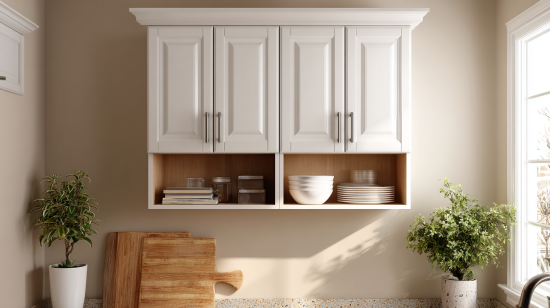
Compact. Deliberate. Deeply underestimated. At just 12 inches tall, the W3012B occupies the awkward zone above appliances, below soffits, or wherever a full-height cabinet would feel architecturally aggressive. It is also the most accessible entry point into the Omaha ecosystem — a low-commitment, high-quality first installation for buyers testing the system before committing to a full room renovation. The recessed panel Shaker door and 6-way adjustable hinges deliver full-line quality at a compact footprint.
Rating: New to the shelves — Be the first to review
Price Range: Starting at $39.98
5. Project Source Omaha Wall Cabinet — 24-in W × 30-in H × 12.5-in D
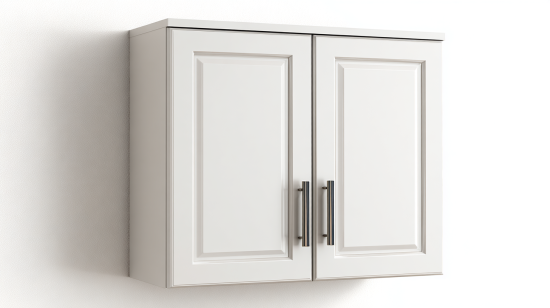
The flanker. The fill cabinet that quietly holds every kitchen together. Twenty-four inches wide is one of those dimensions that appears constantly in kitchen math — the gap beside the refrigerator, the column between a window and a corner, the space that a 30-inch cabinet would crowd and an 18-inch cabinet would abandon. The 24-inch Omaha Wall Cabinet handles those situations with the same CARB II compliant materials and solid poplar construction as the rest of the line. It doesn’t announce itself. It just works.
Rating: New to the shelves — Be the first to review
Price Range: Starting at $54.98
Now that the lineup is visible, the more interesting question is why the Project Source Omaha Wall Cabinet line deserves a different kind of attention than it typically receives. The answer starts with a philosophical argument and ends with an engineering one.
The Contrarian Case for Choosing Unfinished
The kitchen design industry has done an exceptional job of convincing consumers that factory-finished is the goal. The pitch is intuitive: a pre-finished cabinet arrives looking complete. Consistent. Professional. You get exactly what you see on the showroom floor, and you don’t have to make any more decisions.
What that argument strategically omits is this: factory finishing eliminates your choice permanently. Once that coat of paint or stain is baked on, you are locked into a decision made by someone else, for an average buyer, in a palette chosen to appeal to the broadest possible market. Your wall color, your countertop material, your hardware finishes, your personal aesthetic sensibility — all of them have to negotiate with a color someone else picked.
The Project Source Omaha Unfinished Wall Cabinet starts from a fundamentally different premise. It arrives ready to paint or stain right out of the box, with no sanding required. That sentence, read slowly, is not a limitation. It is a specification. The surface is prepared. The material is receptive. You choose the color, the sheen, the finish technique, and the character. You want a matte chalk-painted farmhouse expression? Done. A rich walnut stain that reads more like furniture than cabinetry? Also done. A bold cobalt blue that has never appeared in any factory finish catalog? That’s yours.
This is the audiophile parallel that resonates most strongly. In serious audio, the listeners who understand sound best consistently prefer components that let them tune the system to their specific room and preference — rather than accepting a DSP-corrected, algorithmically averaged signal chain that makes the aesthetic call without them. The unfinished cabinet is the passive loudspeaker to the pre-finished cabinet’s all-in-one system. One trusts your judgment entirely. The other assumes you don’t have enough of it to be trusted.
The Project Source Omaha Wall Cabinet trusts your judgment.
Frameless Construction: The 20% That Quietly Changes Everything
If the unfinished surface is the philosophical argument for the Omaha line, frameless construction is the engineering one — and it is a persuasive one.
Traditional face-frame cabinetry, which dominated American kitchens for most of the twentieth century, places a structural frame of solid wood across the front face of the cabinet box. That frame contributes to the visual language of a certain kind of cabinet aesthetic. It also consumes interior space. Every inch of face-frame width is an inch of storage depth that your plates, your mixing bowls, and your dry goods cannot occupy.
Frameless construction removes that frame entirely, exposing the full interior width and height of the cabinet box to direct access. The result is not subtle: Project Source Omaha Wall Cabinets provide 20% more usable storage compared to equivalent face-frame cabinets. On a 36-inch-wide wall cabinet, that difference is not cosmetic. It is the difference between accommodating your full set of dinner plates and having to leave two stacks on an open shelf.
There is also a functional elegance to frameless design that becomes intuitive once experienced. Doors close flush with the box face. Access requires no negotiation with a protruding frame. The interior presents its full volume without apology. It is a construction philosophy that has been standard in European cabinetry for decades, and it arrives here in the Omaha line at a price point that does not require a renovation budget to justify.
Solid Poplar: An Honest Material Doing Its Best Work
The door on every Project Source Omaha Wall Cabinet is solid poplar — a material choice that rewards examination.
Poplar occupies a sensible position in the hardwood spectrum. It is harder and more dimensionally stable than pine, slightly softer than maple or cherry, and possesses a fine, consistent grain structure that accepts paint with extraordinary evenness. It machines cleanly. It holds hardware securely. It responds to the humidity fluctuations that kitchen environments generate without the movement that more reactive wood species exhibit.
What poplar is not is a compromise. Solid wood door construction at this price point is a genuine specification achievement. A significant portion of cabinets in this category substitute MDF wrapped in thermofoil, hollow-core doors, or printed foil overlays — materials that perform acceptably in a showroom and begin to reveal themselves over time through delamination at edges, swelling around moisture sources, and an inability to be refinished when style changes demand it. Solid poplar doors age honestly. They do not peel. They do not delaminate. They respond to a fresh coat of paint exactly the way they responded to the first.
The recessed panel Shaker door style is also the correct aesthetic decision for an unfinished line, and it is worth understanding why. Shaker is not a trend. It is a design grammar so fundamental — rooted in proportion, craft, and restraint — that it functions across kitchen styles spanning ultra-modern to historical restoration. The recessed panel adds dimension to what would otherwise be a flat surface, creating shadow lines at the edges that catch light differently depending on finish color and gloss level. On an unfinished canvas, that dimensionality is entirely yours to develop.
The 6-Way Adjustable Hinge: A Hardware Specification That Earns Its Mention
Hardware is where cabinet quality frequently reveals itself in the most prosaic way: the door that starts to drift after a year, the hinge that emits a groan under load, the gap that was flush at installation and is no longer. These are the slow failures of under-specified hardware, and they are entirely avoidable.
The 6-way adjustable hinges on every Omaha Wall Cabinet allow for precise micro-adjustment along all the axes that installation reality demands: vertical position, horizontal position, and depth. This is the kind of hardware that acknowledges a basic truth about residential construction — walls are rarely perfectly plumb, and no installation is precisely level. 6-way adjustability means the cabinet door adapts to the space rather than demanding the space accommodate it.
Pair that with natural woodgrain laminated interiors, and you have a cabinet interior that performs as well as it presents. The laminated surface is resistant to moisture, grease, and the casual indignities of kitchen life, and it cleans with nothing more aggressive than a damp cloth. It is a surface that looks considered because it is.
CARB II Compliance: The Specification That Separates the Careful from the Careless
Cabinet interiors are built from composite wood panels — furniture board, particleboard, engineered wood. These materials are excellent for stability and consistency, but their manufacturing process can introduce formaldehyde-based binders that off-gas into living spaces over time. In lesser products, this specification is quietly omitted from product descriptions.
All Project Source Omaha cabinets are constructed with CARB II compliant materials — meeting the California Air Resources Board Phase 2 standard, the most rigorous domestic benchmark for formaldehyde emissions from composite wood products. In a kitchen, where you prepare food, where children may stand at counter height, and where ventilation is not always optimal, this standard is not bureaucratic boilerplate. It is a meaningful commitment to the long-term air quality of the room. The Omaha line leads with it. That confidence is earned and worth noting.
Ready to Assemble: The Part the Critics Get Wrong
There is a persistent prejudice against RTA — Ready to Assemble — cabinetry in renovation-literate circles. The assumption is that factory-assembled means superior, and that requiring the buyer to complete assembly signals either inferior quality or unnecessary complexity. Both assumptions are wrong.
Ready-to-assemble construction is not a cost-cutting shortcut. It is, in practical and logistical terms, the more sensible delivery format for large, heavy items. Flat-packed cabinets ship at dramatically lower volume and weight than pre-assembled equivalents, which reduces in-transit damage rates, simplifies handling during a renovation when multiple trades are active simultaneously, and allows individual components to be staged and maneuvered through tight spaces without the difficulties that fully assembled boxes introduce.
The assembly process itself is supported by Assembly Assist Videos — a specification detail that matters more than it sounds. Not a photocopied schematic with ambiguous isometric arrows, but actual video guidance for actual people completing an actual installation. For a first-time assembler, this is the difference between confidence and frustration. For an experienced installer, it is confirmation that the manufacturer understands who is actually putting this product together.
And when the cabinet is assembled, it does not feel assembled. It feels like a cabinet.
Warranty and Purchasing Confidence
Every Project Source Omaha Wall Cabinet carries a one-year limited warranty — a commitment that covers manufacturing defects and calibrates buyer expectations honestly. This is not a lifetime warranty, and presenting it as one would be dishonest. But it is a meaningful signal from a brand that trusts its own quality control enough to put a formal guarantee behind it. Combined with the price match guarantee available through Lowe’s — match it if you find a lower price on the exact same item — the Omaha line reduces purchasing risk to a level that the category rarely achieves at this price point.
The Real Competition
Here is the contrarian capstone, and it is worth saying clearly.
The Project Source Omaha Wall Cabinet is not positioned against premium custom cabinetry. The comparison is fair and the difference is expected. What it does compete with directly is the mediocre middle of the market: the pre-finished, face-frame, entry-level cabinet that arrives looking acceptable, charges a premium for the convenience of a factory finish, and delivers a product that limits your creative and practical options for the entire remaining life of your kitchen.
Against that field, the Omaha Wall Cabinet does not merely hold its own. It wins on the metrics that matter most over time: material quality, construction philosophy, storage efficiency, hardware precision, long-term refinishability, and genuine adaptability to the buyer’s actual vision.
The only thing it withholds is the false comfort of a decision already made. The finish is yours. The color is yours. The character of the space is yours.
For buyers who understand what they are actually evaluating, that is not a gap in the product. That is the entire product.
The Unfinished Story Is Yours to Finish
Cabinet shopping is, in the best circumstances, a low-adrenaline exercise in comparing specifications that most buyers have not been given the tools to evaluate. The category is dominated by products that look similar, described in language designed to smooth over meaningful differences, sold primarily on the visual impression of a showroom door sample.
The Project Source Omaha Wall Cabinet by Project Source rewards the buyer who asks better questions. What is the door actually made of? How is the box constructed? What compliance standards does the interior material meet? Can I finish this the way my kitchen actually demands?
The answers, consistently, are the right ones.
Solid poplar doors. Frameless construction. CARB II compliant materials. 6-way adjustable hinges. No sanding required. One-year warranty. Available in configurations from 12 to 36 inches wide and 12 to 30 inches tall. Ready to be exactly what your kitchen needs it to be — which, as it turns out, is a promise that no pre-finished cabinet can genuinely make.
The unfinished cabinet is not the incomplete product. It is the one that reserves the final chapter for the person who actually lives in the room.